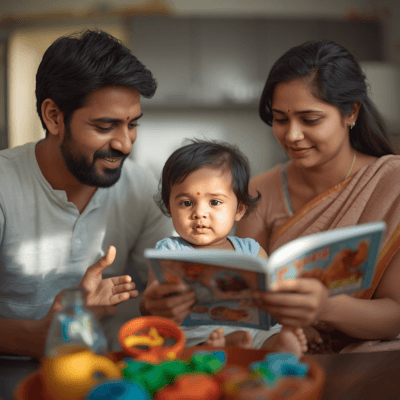
Children vary enormously — one healthy child says their first word at 10 months, another at 15. Milestones are ranges, not deadlines. Still, knowing the typical map helps you enjoy each stage and notice early if your child needs support.
Birth to 6 months: the listening stage
Your baby is soaking up the melody of your language long before understanding words. Typically by 6 months, babies startle at loud sounds, calm to a familiar voice, coo and gurgle, laugh, and begin turning toward sounds. Talk and sing to your baby constantly — they're listening more than you know.
6 to 12 months: the babbling stage
Babbling begins — "bababa", "dadada" — and gradually starts to sound conversational, with adult-like rises and falls. By the first birthday most babies respond to their name, understand "no", wave bye-bye, point at interesting things, and may say one or two words.
💡 Tip
Pointing is a milestone worth celebrating as much as a first word. It means your baby understands that two people can share attention on the same thing — the foundation of all conversation.
12 to 18 months: first words
Words arrive one at a time — names for people, foods, toys and animals. By 18 months, many children use 10–25 words and follow simple instructions like "give me the ball." Understanding always runs ahead of speaking at this age.
18 to 24 months: the word explosion
Most toddlers hit a vocabulary growth spurt — learning several new words a week — and reach roughly 50+ words by age two, when the first two-word combinations appear: "more juice", "mama come". This is one of the most important milestones in all of language development.
2 to 3 years: little sentences
Vocabulary grows from 50 words to several hundred. Two-word phrases stretch into three- and four-word sentences. Your child starts asking "what's that?" endlessly, uses pronouns (me, you, mine), and familiar adults understand most of their speech. By 3, unfamiliar listeners should understand at least half.
3 to 4 years: storytellers in training
Children begin telling simple stories, answering who/what/where questions, using sentences of four or more words, and playing imaginatively with others. Speech becomes clear enough that strangers understand nearly everything, though sounds like r, s, l and th may still be developing.
4 to 6 years: conversation and beyond
Grammar matures, stories gain beginnings and endings, and children learn to take turns in real conversations, understand jokes, and follow multi-step instructions. By 6, most speech sounds are accurate and your child is ready to map spoken language onto reading and writing.
⚠️ Important
At any age, seek an evaluation promptly if your child loses skills they once had, if they aren't combining words by two and a half, or if you simply feel something isn't right. Parent instinct is a legitimate clinical signal.
A gentle reminder
Milestone lists exist to guide attention, not to grade children. If your child is behind in one area and thriving in others, a screening gives you clarity — and if support is needed, starting early is the single most effective thing you can do.