Parents often imagine language help means worksheets and drills. Speech-Language Pathologists will tell you the opposite: for young children, language grows fastest inside warm, everyday interactions. Here are fifteen habits that cost nothing and fit into the day you're already having.
Talk techniques
1. Narrate your day (self-talk)
Describe what you're doing as you do it: "I'm cutting the apple. Round apple! Now — crunch!" Your child hears words attached to real actions, which is exactly how vocabulary sticks.
2. Sportscast your child (parallel talk)
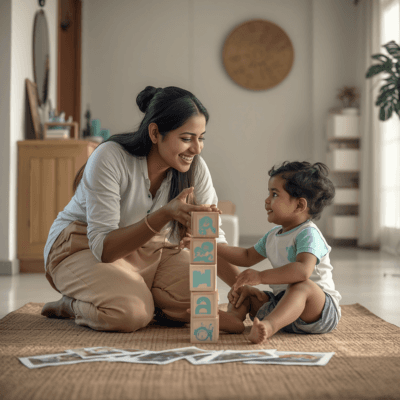
Describe what they are doing: "You're stacking blocks. Up, up, up… oh no, it fell down!" No questions, no pressure to answer — just language wrapped around their attention.
3. Add one word (expansion)
Whatever your child says, say it back with one more word. Child: "Car!" You: "Fast car!" Child: "Daddy go." You: "Yes, Daddy is going to work." You're modelling the next step without correcting.
4. Wait — longer than feels natural
After you say something, count silently to five. Children need more processing time than adults, and many "quiet" children simply never get a long enough pause to jump in.
💡 Tip
Turn statements into chances to respond. Instead of "Do you want the ball?", try holding the ball, looking expectant, and saying "Ball… ?" then waiting. Anticipation is a powerful word-puller.
Routine gold mines
5. Bath time
Body parts, actions (splash, pour, wash), concepts (wet, dry, warm, cold, in, out) — bath time is a complete vocabulary lesson with built-in fun.
6. Mealtimes
Offer choices out loud: "Idli or dosa?" Choices force a communication moment and give your child power — the best motivation to speak.
7. Getting dressed
"Arms up! Where's your hand? There it is — push!" Dressing has natural repetition every single day, and repetition is how toddlers learn.
8. Shopping
Name what goes in the basket. Let your child hold and "help." At the vegetable stall: colours, sizes, heavy and light.
Play that grows words
9. Follow their lead
Play with what your child is already interested in, rather than redirecting them to what you planned. Children learn far more words inside their own attention than inside ours.
10. People games
Peek-a-boo, chase, tickle-countdowns. These teach turn-taking — the skeleton of conversation — and create irresistible moments to request "more!" and "again!"
11. Pretend play
Feed the teddy, put the doll to sleep, make the toy cow say moo. Pretend play and language grow on the same tree; watering one waters the other.
12. Sing — and pause
Familiar songs with actions ("Twinkle twinkle little…") then stop before the last word and wait. The pull to fill in a known song is remarkably strong.
Book habits
13. Read the same book again (and again)
Repetition isn't boring to a toddler — it's mastery. Each rereading lets them predict, fill in words, and eventually "read" it to you.
14. Talk about the pictures, not just the text
Point, label, ask "where's the…?", let them turn pages. For toddlers, a book is a conversation starter, not a script.
15. Make books part of the routine
A few minutes after breakfast and before bed adds up to hundreds of reading sessions a year. Routine beats duration.
⚠️ Important
Reduce background TV during play and meals. Constant background audio measurably reduces the amount and quality of parent-child talk — the exact ingredient language grows from.
When home activities aren't enough
These habits help every child, but they're not a substitute for professional support when it's needed. If your child's communication seems behind for their age, take a structured screening — you'll either get reassurance or a clear reason to act early. Both are wins.